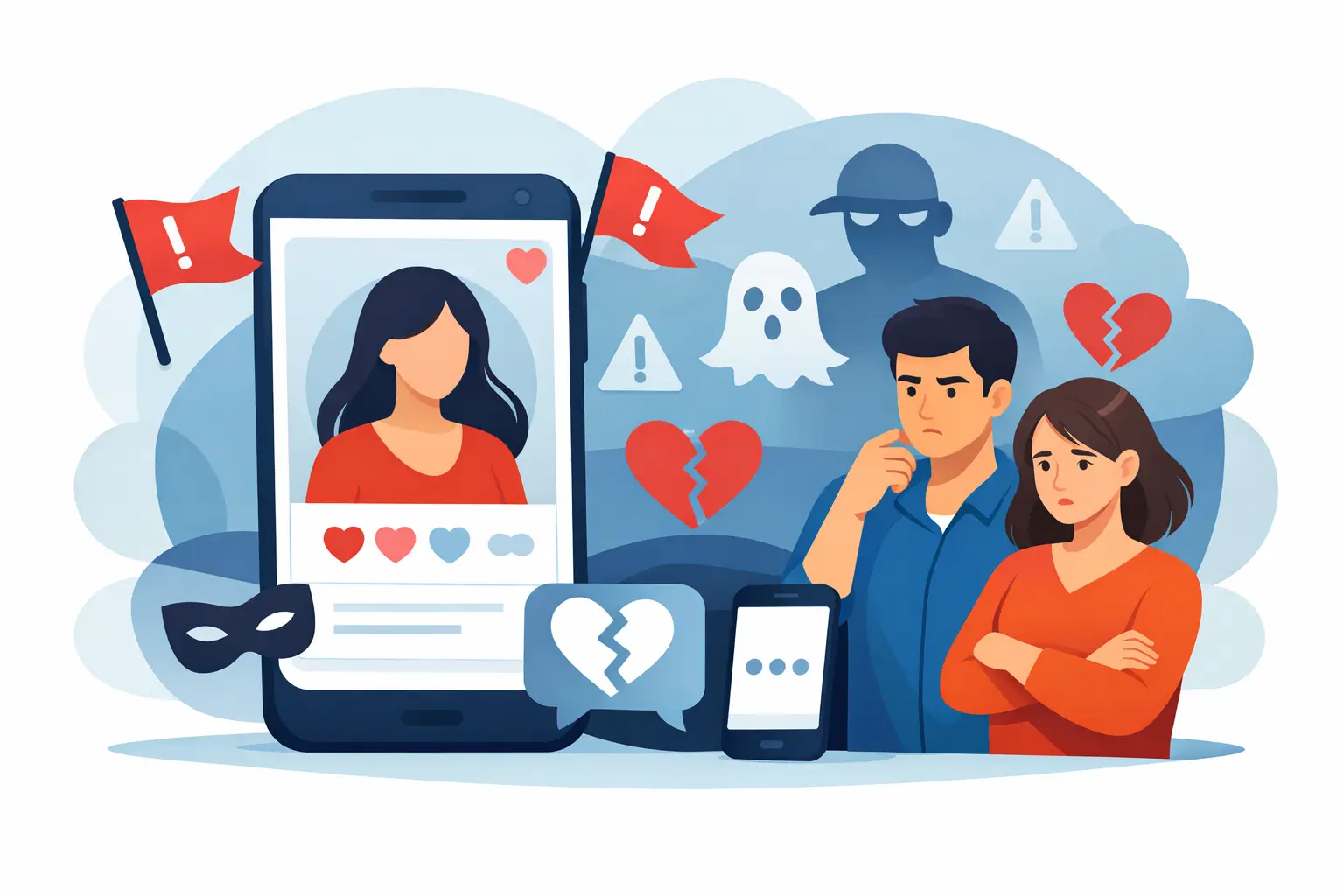
A profile says they want a relationship. Their photos say nightlife every weekend. Their prompts reveal nothing, and their first message arrives at 11:48 p.m. These are the top dating app red flags people learn to spot after too many dead-end conversations. But the deeper problem is not just who is on the app. It is what the app is built to reward.
Most dating platforms train people to make fast, low-context decisions, then keep them engaged long after the experience stops producing anything meaningful. That creates two categories of red flags: signals from individual users and signals from the dating system itself. If you want a serious relationship, you need to recognize both.
Top Dating App Red Flags in a Profile
A dating profile is not a psychological evaluation. People are allowed to be private, funny, awkward, or simply bad at writing prompts. One typo or an unpolished photo is not a reason to write someone off. The useful red flags are patterns that show a mismatch between stated intention, actual behavior, and basic emotional availability.
The relationship goal is strategically vague
“Seeing where things go” is not inherently wrong. For someone who truly is open to connection without forcing a timeline, it can be honest. But vague language becomes a red flag when it is paired with relationship-coded behavior: intense flirting, constant messaging, future talk, then withdrawal as soon as clarity is required.
For intentional daters, ambiguity has a cost. It consumes attention, creates false momentum, and pushes the real compatibility conversation further down the road. A person does not need to promise marriage on date one. They should be able to say whether they are genuinely available for a committed relationship.
Their profile contains no usable information
A photo-only profile may earn plenty of attention. That does not make it a strong dating signal. When someone gives you no sense of their values, routines, interests, communication style, or what they want, you are being asked to supply the narrative yourself.
That gap is where projection thrives. You start imagining depth because their face is appealing, not because they have shown you anything that supports the idea. Attraction matters, but attraction without context is just a guess wearing good lighting.
Every prompt is a performance
There is a difference between personality and branding. A profile packed with status markers, curated lifestyle signals, and references designed to impress can indicate someone is optimizing for attention rather than connection. The issue is not that they travel, exercise, have a great career, or enjoy nice restaurants. The issue is whether there is any evidence of a person behind the pitch.
Look for specificity that makes conversation possible. A serious dater does not need a perfect profile. They need enough self-awareness to give another person a real starting point.
Bitterness is doing the talking
“Don’t waste my time.” “No drama.” “If you can’t handle me, swipe left.” These lines may be understandable after disappointing experiences, but they still matter. They often signal that someone is entering a new interaction ready to punish a stranger for what a previous stranger did.
Dating fatigue is real. So is emotional spillover. Someone who can name a boundary without contempt is likely in a better place than someone whose profile reads like a warning label.
The Red Flags That Show Up After You Match
Profiles are limited evidence. Messaging and follow-through reveal much more. This is where people often override their own judgment because a match is attractive, charming, or finally seems promising.
Watch the pattern, not the isolated moment. A delayed reply during a demanding week is normal. A repeated cycle of intensity, disappearance, and reappearance is information.
Fast intimacy without real knowledge. Love-bombing does not always look dramatic. It can sound like premature exclusivity talk, exaggerated compliments, or emotionally loaded messages before the person has asked basic questions about your life.
Conversation that stays permanently shallow. Banter is a good start, not a relationship strategy. If every exchange is flirting, memes, and vague plans, the connection may be designed to entertain rather than progress.
Avoidance disguised as spontaneity. “Let’s play it by ear” can be flexible. It becomes a problem when concrete plans never materialize or are routinely canceled at the last minute.
Boundary testing. Pressure to move off the app immediately, share personal details, send photos, meet at an inconvenient hour, or lower a boundary you stated clearly is never a minor issue.
Selective availability. If someone only appears late at night, responds only when bored, or disappears whenever the conversation turns substantive, believe the behavioral pattern over the occasional affectionate message.
The goal is not to interrogate every match. It is to stop treating inconsistency as a puzzle you can solve with more effort. The right connection does not require you to decode basic respect.
The Biggest Red Flag May Be the App Itself
Here is the uncomfortable truth: many frustrating dating experiences are not user failures. They are product outcomes.
Swipe-based platforms are typically designed around volume, novelty, and return visits. Those goals are understandable for an attention business. They are not the same as helping two compatible people recognize a viable relationship and move toward it.
When a platform gives you hundreds of faces, minimal context, and intermittent rewards, it encourages snap judgments. You evaluate people as inventory. Other people evaluate you the same way. The result is a marketplace where the next possibility can always feel more compelling than the person currently in front of you.
That design creates its own top dating app red flags. If an app makes it easy to accumulate matches but hard to understand compatibility, it is prioritizing activity over outcomes. If it measures success by time spent browsing rather than meaningful conversations, dates, or durable relationships, your exhaustion is not an accident. It is a predictable consequence of the model.
Endless choice can weaken discernment
More options do not automatically create better decisions. Past a certain point, choice produces comparison fatigue. You become less able to notice what actually matters because every promising person is assessed against an imaginary stream of future alternatives.
For a casual experience, that trade-off may be acceptable. For someone dating with purpose, it is expensive. It turns emotional energy into a renewable resource for the platform instead of an investment in a real connection.
Chemistry-first sorting misses the conditions for fit
Photos can help establish attraction. They cannot tell you how a person handles conflict, whether their life-stage timing aligns with yours, how they communicate under stress, or whether your visions of partnership are compatible.
Those factors are not boring details to uncover after chemistry. They are often the foundation of whether chemistry can become a relationship. A system that ranks people primarily on appearance and short-form prompts leaves the highest-stakes variables largely to chance.
What to Look for Instead
Better dating is not about becoming suspicious of everyone. It is about replacing guesswork with clearer evidence. Look for alignment between a person’s words and actions, interest that is reciprocal rather than performative, and a pace that allows trust to develop without pressure.
Also look for platforms and processes that respect your attention. A serious dating experience should help you narrow intelligently, not keep you endlessly browsing. It should give you more context before you invest, more clarity about why a match may fit, and more room to assess the parts of compatibility that photos cannot capture.
That is the premise behind compatibility intelligence: matching should account for personality, relationship goals, behavioral patterns, and timing, then make the reasoning understandable. Daty.ai is built around that shift because dating does not need more noise disguised as choice. It needs better decisions.
The most useful red flag is the one that changes your behavior. When a profile is vague, when effort is one-sided, or when an app keeps feeding you possibility without progress, do not argue with the signal. Protect your time, raise the standard for clarity, and leave room for the connection that can actually meet it.