Maya had spent three years becoming very good at dating apps and very tired of dating. Her profile was polished. Her conversations were easy. Her match queue never emptied. Yet each promising start seemed to fail at the same point: after the chemistry, before the relationship. She did not need more people to swipe through. She needed a better way to tell the difference between attraction and alignment.
This compatibility score case study follows a composite scenario built from a familiar problem: two people can look excellent on paper, feel a spark in messages, and still be poorly positioned to build a life together. The issue is not that people are bad at dating. The issue is that swipe apps are designed to maximize activity, not decision quality.
A compatibility score should not act like a romantic credit score. It should not reduce a person to a number, announce a soulmate, or pretend that human connection is predictable with perfect certainty. Its real job is more useful: organize the signals that matter, expose potential friction early, and explain why a match may be worth a serious conversation.
The case: a strong match that conventional apps would miss
Maya is 34, recently settled into a demanding but stable career, and wants a committed relationship with a realistic path toward partnership. She values curiosity, direct communication, independence, and shared responsibility. Her dating history tells a consistent story: she is drawn to charismatic, spontaneous people, then becomes exhausted when she carries the emotional planning.
Ethan is 36, thoughtful, career-established, and equally clear that he wants a relationship rather than an endless stream of dates. On a conventional app, he may not initially stand out to Maya. His photos are warm but not optimized for instant attention. His profile communicates more substance than spectacle. A swipe system gives their potential one fast, visual test.
That is a bad test for what they are actually trying to build.
An intelligence-based matching model looks at a wider set of signals. It considers personality patterns, relationship expectations, life-stage readiness, behavioral preferences, and the way each person approaches conflict, communication, and commitment. It does not ask only, “Would they click?” It asks, “What kind of relationship are they likely to create together?”
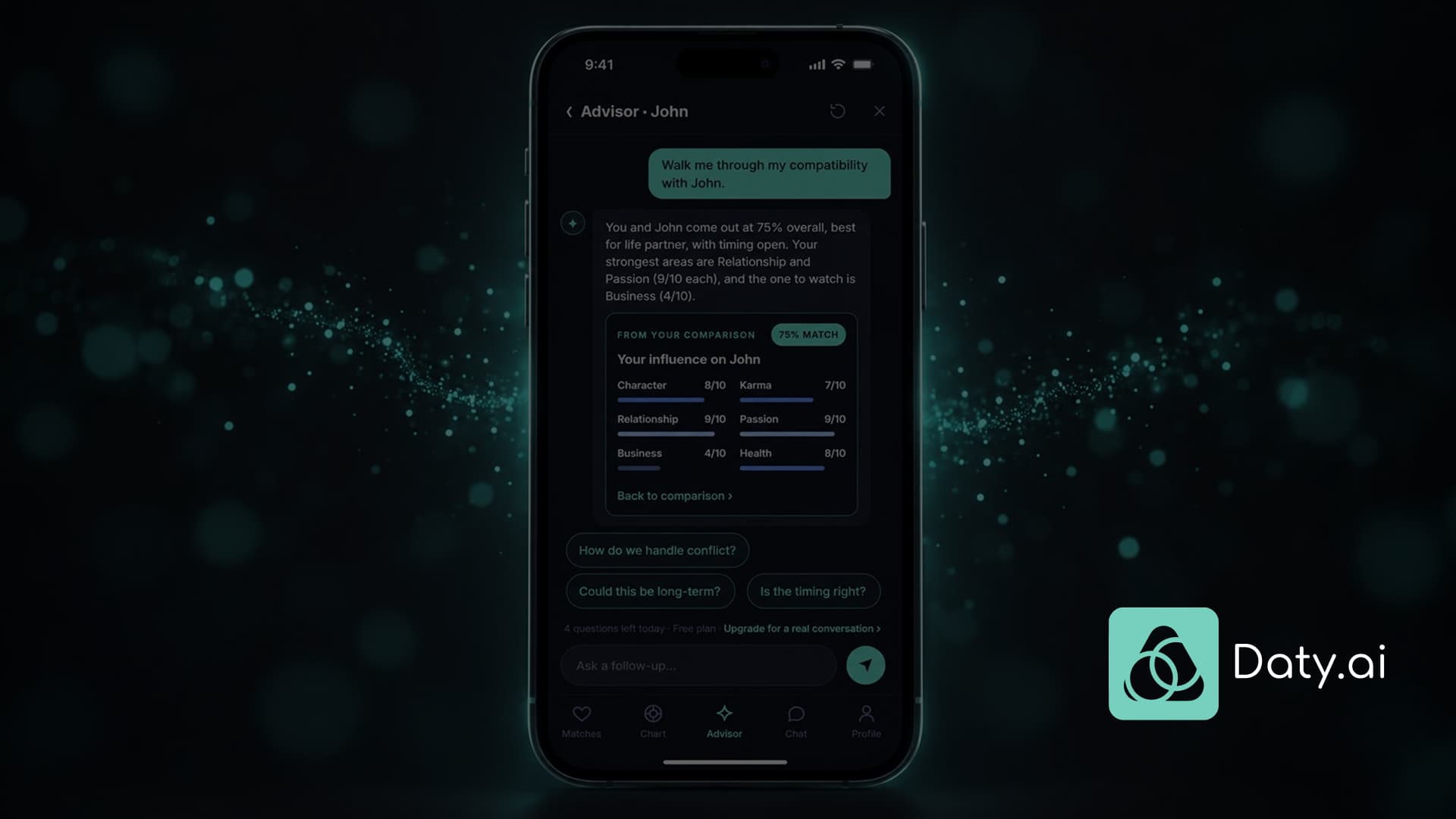
Maya and Ethan earn a high overall compatibility score, but the score is not the headline. The explanation is.
What the compatibility score actually measures
A meaningful score needs layers. Without them, it is just a prettier version of swiping.
For Maya and Ethan, the model finds strong alignment in relationship intent. Both are looking for a committed partnership now, not vaguely someday. That timing matters more than dating apps admit. Two people can have excellent personality fit and still fail because one wants emotional intimacy while the other wants optionality.
They also show a useful complement in communication. Maya tends to process externally and prefers direct conversation when something feels off. Ethan is more reflective, but he reliably returns to difficult topics rather than avoiding them. This is not friction-free compatibility. It is workable compatibility. The system can identify that they may need different pacing in tense conversations while also recognizing a shared willingness to repair.
Their lifestyle alignment is similarly strong. Both want urban access without centering their lives on nightlife. Both value financial stability, close friendships, and room for personal interests within a relationship. These details can sound mundane beside chemistry, but mundane is where long-term compatibility lives. A relationship is built in calendars, spending habits, energy levels, and how two people handle an ordinary Tuesday.
The score also identifies one important watch-out: Maya’s past attraction pattern. Ethan’s steadiness may initially read as less exciting than the inconsistent intensity she has learned to associate with chemistry. That does not make the match wrong. It gives her a more honest question to consider: is she reacting to genuine lack of attraction, or to the absence of familiar instability?
That is where compatibility intelligence becomes self-knowledge, not just recommendation software.
Why an explanation changes the dating decision
A number without reasoning creates false authority. “You are an 89% match” may feel scientific, but it tells a person almost nothing about what to do next. It can also hide trade-offs that deserve attention.
In this case, an explainable system would tell Maya and Ethan that their strongest points are shared intent, compatible life structure, and a healthy conflict-repair outlook. It would also make the likely pressure point visible: they may differ in how quickly they verbalize needs and process emotional tension.
That explanation changes the first date. Instead of performing for attraction alone, they can explore the questions that actually matter. How do they each define partnership? What does support look like during a difficult work season? When conflict shows up, do they need space, reassurance, directness, or time to think?
This is not about turning a first date into an interview. It is about giving two intentional people a better starting point than “So, what brings you here?” A good match deserves a conversation designed to reveal whether the connection can hold weight.
The score is a decision aid, not a verdict
There is a trap in every compatibility model: mistaking correlation for destiny. People change. Context changes. A person can report one set of values and behave according to another. No AI system can guarantee love, predict every conflict, or eliminate the vulnerability required to date seriously.
The value lies in reducing avoidable randomness.
For Maya, the score does not tell her to choose Ethan. It tells her he is a high-potential match for reasons that are visible and relevant to her goals. She still has to meet him, feel the conversation, notice how he treats people, and decide whether attraction grows in real life.
For Ethan, the score does not erase the need for effort. Alignment only creates a better probability landscape. It does not create trust on his behalf. He still needs to communicate clearly, follow through, and show that his stated intentions are real.
That distinction matters because many dating products sell certainty when users need clarity. Certainty is fiction. Clarity is power.
What happened after the match
Maya and Ethan met for coffee, then extended the date into a walk because the conversation did not feel forced. Their early connection was not loud or cinematic. It was specific. They found themselves discussing how they each recovered after past relationships, what commitment had taught them, and how they wanted daily life to feel with another person in it.
The first real disagreement arrived in week four. Maya interpreted Ethan’s slower response during a stressful work deadline as withdrawal. Ethan experienced Maya’s direct request for reassurance as pressure at the exact moment he felt overloaded. A conventional dating app would have nothing to say about this moment. It delivered the match, then disappeared.
The compatibility explanation gave them language for the tension. Maya named her need without accusing him of indifference. Ethan clarified that he needed temporary focus, not emotional distance, and agreed to communicate that more explicitly next time. The point was not that they avoided conflict. The point was that the conflict was understandable, discussable, and repairable.
That is a far more meaningful measure than whether they traded clever messages for two weeks.
What this case study reveals about better matching
The swipe model treats abundance as the product. More profiles, more likes, more notifications, more chances to stay engaged. But for people seeking a serious relationship, abundance becomes noise when there is no intelligent way to sort for fit.
A compatibility score changes the operating system. It shifts the focus from broad discovery to informed selection. It asks for more than a face, a job title, and a split-second judgment because long-term partnership demands more than surface-level data.
Daty.ai is built around that premise: dating is not a game of maximizing exposure. It is a decision-intelligence problem. The right system should help people understand whom they may fit with, when they are ready for that fit, and why the recommendation deserves attention.
The trade-off is clear. A deeper model asks users to be more honest, more reflective, and more willing to confront their own patterns. Not everyone wants that. Some people prefer the low-stakes entertainment of browsing. But for anyone exhausted by repetitive first dates and dead-end chemistry, reflection is not extra work. It is the work that prevents more wasted time.
The next time a match feels promising, do not ask only whether the conversation is easy. Ask what the connection is built to support. Attraction may open the door, but alignment determines whether there is somewhere worth going together.