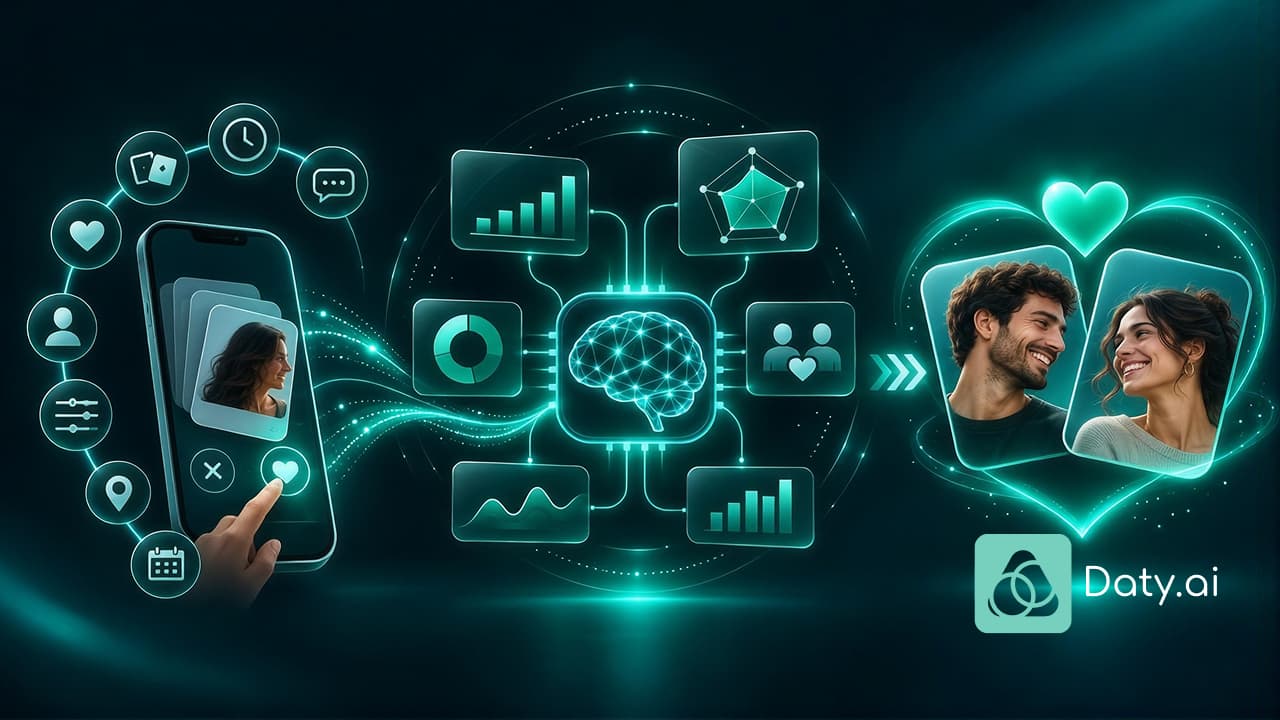
Most dating apps treat your attention as the product. They measure what makes you pause, swipe, return, and keep browsing. That is very different from understanding what makes a relationship work. How AI analyzes dating behavior should be about finding meaningful alignment, not building a more efficient slot machine.
For intentional daters, the promise of AI is not that a machine can predict love with certainty. It cannot. The real opportunity is more useful: AI can recognize patterns people routinely miss when they are exhausted, hopeful, attracted, busy, or caught in the same dating loop. It can turn scattered signals into a clearer picture of compatibility, readiness, and relational fit.
The difference between activity data and relationship intelligence
A conventional app sees behavior through an engagement lens. Did you open the app? Which profile held your attention? How many messages did you send? Did you reply? Those signals can be useful, but alone they optimize for activity. More swiping does not mean better outcomes. In fact, endless choice often creates worse decisions, lower follow-through, and more dating fatigue.
Relationship intelligence asks different questions. What kind of connection makes a person feel secure and engaged? Do they communicate directly or avoid difficult conversations? Are their lifestyle preferences compatible with the people they pursue? Do their stated goals match their patterns of action? Are two people at a similar enough life stage to build something real?
The distinction matters because chemistry is only one layer of a durable match. Attraction gets attention. Alignment determines whether attention becomes momentum.
How AI analyzes dating behavior beyond the profile
A well-designed compatibility system does not reduce someone to a photo, a job title, or a few prompts. It looks for patterns across multiple layers of information, while making the reasoning visible to the user.
It maps communication patterns
Conversation behavior reveals more than polished profile answers. AI can assess broad patterns such as reciprocity, consistency, openness, responsiveness, emotional tone, and whether two people naturally build on each other's ideas. It can flag a mismatch between someone who prefers frequent, direct communication and someone who is reliably vague or intermittent.
That does not mean an algorithm should punish someone for taking a day to respond. People work, travel, care for families, and have different communication rhythms. Context matters. The goal is not to enforce a single standard of dating behavior. It is to identify whether two people have compatible expectations and whether their patterns support trust.
It compares values with real-world trade-offs
Nearly everyone says they value honesty, kindness, ambition, and family. Those answers are too broad to do much work on their own. Stronger AI systems look for the practical meaning behind the labels.
For one person, ambition may mean starting a company and accepting irregular hours. For another, it may mean career stability with protected evenings and weekends. Both are ambitious. They may still be incompatible in daily life. The same applies to money, religion, location, social energy, children, health, conflict, and independence.
AI can organize these distinctions into a compatibility model, showing where two people are likely aligned, where they may need negotiation, and where the friction is structural rather than temporary. That is more honest than calling every match a great match because both people selected the same three interests.
It accounts for timing and life stage
A highly compatible person can still be the wrong match right now. One person may be ready to build a shared life, while the other is recovering from a serious breakup, considering a move, navigating a demanding career shift, or unsure whether they want children. None of those realities makes someone a bad dater. They change the conditions of the match.
Timing is not a minor detail. It is often the reason promising connections stall. AI can help identify whether two people are not only compatible in theory, but positioned to make similar decisions over the next few years. This is where dating stops being a discovery game and becomes a decision problem.
It recognizes recurring choices
Many people have a type. The problem is that a type can be an attraction pattern, not a compatibility pattern. You may repeatedly choose charismatic but unavailable partners, highly independent partners when you want more closeness, or people whose lives look impressive but do not fit yours.
AI can surface a pattern without shaming the person. It might show that the profiles you pursue most often have traits that correlate with short-lived conversations or mismatched relationship goals. It can then contrast attraction signals with evidence of long-term fit.
That kind of feedback is valuable because self-awareness is difficult when every date feels like an isolated event. Patterns become easier to see when they are viewed across time.
Better analysis requires better inputs
AI is not magic, and it is not a lie detector. Its recommendations are only as useful as the information it receives, the questions it asks, and the goals it is designed to serve.
If a system relies on shallow profile data, it will produce shallow recommendations at scale. If it is built to maximize time in the app, it will learn to prioritize stimulation over alignment. If users give performative answers, hide key constraints, or change their minds, the model has to adapt. People are not static datasets.
That is why serious dating intelligence should combine structured self-reflection with observed behavioral signals and regular opportunities to update preferences. A person may learn after several dates that emotional availability matters more than a shared hobby, or that they need someone with a similar approach to planning, money, or family boundaries. A useful system should evolve with that insight.
Explainability is not optional
The most frustrating recommendation is one that arrives as a black box: high match, no explanation. When the stakes are personal, people deserve more than a percentage score.
Explainable AI gives users the reasoning in plain language. Perhaps two people align strongly on relationship intent, conflict style, social pace, and future plans. Perhaps they differ meaningfully on location flexibility or desired family timeline. The system should show both.
This does two things. First, it helps people make informed choices rather than blindly accepting an algorithm's verdict. Second, it keeps the technology accountable. If the explanation feels inaccurate, incomplete, or based on assumptions, the user can correct it.
Daty.ai is built around this principle: fewer, more intentional recommendations supported by clear reasoning about fit, timing, and the factors that may require an honest conversation.
Where AI should stop
AI can identify patterns. It cannot decide who deserves your trust, tell you whether you feel safe, or replace the experience of being known by another person. It should never turn sensitive personal information into a surveillance project, nor should it make high-stakes claims about mental health, character, or future behavior with false certainty.
Privacy and consent are central here. Users should understand what information is being analyzed, why it is relevant, how long it is retained, and how they can control or delete it. Behavioral insight without user control is just a more sophisticated version of the broken model.
There is also a risk of overfitting. People can grow. Someone's past dating behavior may describe a season of their life, not their permanent capacity for partnership. The best systems treat recommendations as informed hypotheses, not fixed judgments.
The real purpose of AI in dating
The value of AI is not more matches, more notifications, or more reasons to check your phone. It is better signal in a category overwhelmed by noise.
For people who are serious about partnership, that means less time interpreting mixed messages, chasing theoretical potential, and repeating mismatches that were visible from the start. It means receiving recommendations grounded in how you actually live, communicate, prioritize, and make decisions.
The right match will still require courage, curiosity, and real conversation. But you should not have to sort through hundreds of strangers just to find the few connections worth bringing into real life. AI should make that search more human, not less.