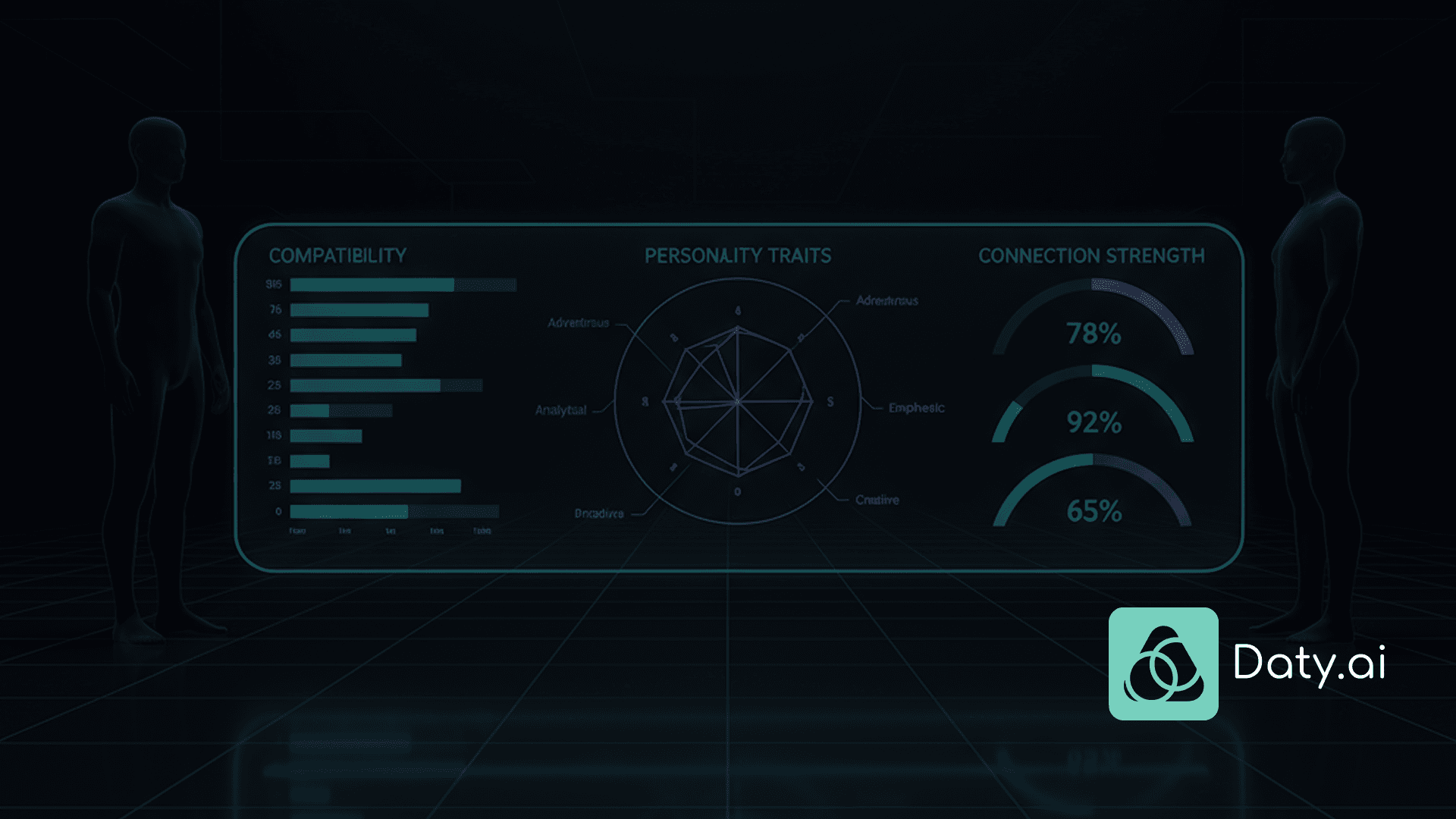
A dating app can show you that someone is nearby, attractive, and willing to match. That is not the same as telling you whether a relationship has a real chance. Match reasoning tools exist to close that gap: they turn compatibility from a vague feeling or a black-box score into a decision you can actually examine.
For serious daters, this distinction is overdue. Swipe culture trained people to evaluate romantic potential through a few photos, a short bio, and a split-second reaction. The result is familiar: too many conversations, too little clarity, and a growing sense that dating has become a second job with worse returns. Better matching is not about producing more options. It is about producing fewer, more intelligible ones.
Why a Match Score Is Not Enough
Most matchmaking systems reduce a person to a single number. You are 87% compatible. Someone else is 92%. The math may look precise, but the number leaves out the question that matters: compatible in what way?
A useful match recommendation needs to distinguish between attraction, relational fit, practical fit, and timing. Two people can share values yet want radically different relationship structures. They can have excellent conversational chemistry but be in incompatible life stages. They can look perfect on paper while bringing conflict patterns that turn a promising connection into a draining one.
A score cannot carry all of that meaning by itself. In fact, a single score can create false confidence because it hides trade-offs. A recommendation system should be able to say, in plain language, that two people align strongly on communication preferences and long-term goals, while also identifying a difference in pace, lifestyle, or conflict style worth discussing early.
That is the shift from matching as sorting to matching as reasoning. The goal is not to declare that an algorithm knows your future. The goal is to make better first decisions with better evidence.
What Match Reasoning Tools Actually Analyze
The strongest match reasoning tools look beyond self-reported interests. Loving the same music or ordering from the same takeout place might create an easy opening line, but it rarely predicts whether two people can build a stable relationship.
Compatibility intelligence is more useful when it considers multiple layers at once. Personality patterns can show how someone processes stress, expresses affection, makes decisions, or seeks closeness. Relationship values reveal what commitment, loyalty, family, autonomy, and emotional availability mean to each person. Behavioral signals can indicate how a person follows through, communicates boundaries, and responds when a connection becomes more real than theoretical.
Timing belongs in the model too. A great match can be wrong for the moment if one person is rebuilding after a major breakup, relocating, focused on a demanding career transition, or uncertain about what they want. Timing is not an excuse to dismiss meaningful potential. It is a practical variable that changes whether potential can become partnership.
This is where conventional apps fall short. They are optimized to keep the feed moving. Compatibility requires the opposite instinct: pause, assess context, and give people a reason to invest their attention selectively.
Explainability Changes the Dating Decision
People do not need an AI system to make romantic choices for them. They need a system that makes the reasoning behind a recommendation visible enough to challenge, trust, or reject.
Explainability matters because dating is personal. If a platform recommends someone, you should not have to accept a mysterious compatibility score on faith. You should be able to understand the major signals behind the recommendation. Perhaps you both prefer direct communication, are aligned on the kind of partnership you want, and have complementary approaches to planning and spontaneity. Perhaps the system also flags that one person needs more alone time than the other.
That explanation does two things. First, it gives you a more intelligent place to begin the conversation. Instead of recycling "How was your weekend?" you can explore a real point of alignment or a meaningful difference. Second, it teaches you something about your own patterns. If recommendations repeatedly show that you thrive with people who communicate differently than your past partners, that insight has value beyond any one match.
Transparency also prevents the technology from becoming another authority figure in your dating life. An explanation is not a verdict. It is a hypothesis based on available information. People are complex, and no system can perfectly account for chemistry, growth, or the unpredictable reality of meeting face-to-face. Good tools make that uncertainty clearer rather than pretending it does not exist.
Better Inputs Create Better Matches
There is an uncomfortable truth behind every recommendation engine: the output cannot be more honest than the input. If people answer dating questions aspirationally instead of truthfully, or present the version of themselves they hope to become, the model starts from distorted evidence.
That does not mean the answer is an endless personality quiz. More questions do not automatically create more insight. The better approach is to ask questions designed to surface decision-relevant patterns: how you handle disagreement, what consistency means to you, how you balance independence and partnership, what your actual weekly life looks like, and what type of relationship you are ready to build now.
Behavior can strengthen those answers over time. If someone says they value thoughtful communication but consistently disappears after early conversations become substantive, that pattern matters. If they say they want commitment and their choices support that goal, that matters too. Behavioral data should be handled carefully and ethically, but ignoring behavior altogether leaves matchmaking trapped in self-description.
Privacy is part of the trade-off. A compatibility system may need deeper information than a photo-first app, which makes consent, data boundaries, and user control non-negotiable. Serious daters should not have to choose between better recommendations and ownership of their personal information. A credible platform explains what it uses, why it uses it, and what the user can control.
The Real Metric Is Fewer Dead Ends
The dating industry often treats engagement as success. More swipes, more messages, more time in the app. But someone looking for a lasting relationship has a different definition of value: fewer dead-end dates, less emotional churn, and more conversations that deserve a second look.
That is why a smaller set of highly reasoned recommendations can outperform an endless queue of profiles. Abundance feels productive until you realize it has made every decision harder. When there is always another profile one swipe away, people delay judgment, avoid vulnerability, and treat promising connections as disposable.
Reasoning tools introduce productive constraints. They help people focus on the signals that carry actual relationship weight, rather than confusing novelty with compatibility. They also create better expectations. A match may be recommended because there is substantial alignment, not because a system is promising effortless perfection.
Daty.ai is built around this premise: dating should function as compatibility intelligence, not an engagement loop. The purpose of the technology is not to make romance feel clinical. It is to remove some of the noise that has made intentional dating so exhausting.
How to Use Compatibility Reasoning Without Overthinking
A thoughtful recommendation is an invitation to investigate, not a shortcut around human judgment. Use the explanation to ask better questions early. If the match highlights alignment around family goals, talk about what that looks like in practice. If it identifies different social needs, discuss how each of you recharges and what partnership looks like during busy weeks.
Do not treat every mismatch as a warning sign. Some differences are healthy and complementary. A planner and a spontaneous person may balance each other well. What matters is whether the difference produces curiosity and mutual accommodation or recurring resentment. The same is true for personality labels: they can provide language, but they should never become a cage.
Pay attention to what happens after the explanation ends and the interaction begins. Does the person show consistency? Do you feel more like yourself around them, not less? Can both of you address an awkward moment without retreating into silence or performance? Those are the signals no profile can fully predict, and they remain central.
The best use of match reasoning tools is not to outsource your instincts. It is to give your instincts better evidence. When dating stops rewarding endless browsing and starts rewarding clear choices, people get back the time and emotional energy needed to recognize a relationship worth building.