A strong profile can tell you what someone believes. It rarely tells you what happens when plans change, communication gets uneven, or intimacy starts asking for more than chemistry. This behavioral compatibility case study examines that gap: the distance between two people who look aligned on paper and two people who can actually build a relationship.
That distinction is where swipe-based dating breaks down. It makes a decision from photos, prompts, and a brief exchange, then leaves people to discover the meaningful variables through weeks of guesswork. The result is familiar: attraction, optimism, a promising first date, and a sudden collapse that neither person can fully explain.
Behavioral compatibility is designed to make more of that pattern visible before people invest their time.
Behavioral Compatibility Case Study: The Match That Looked Perfect
Consider an illustrative composite of two intentional daters, Maya and Daniel, both in their mid-30s. They each want a committed relationship, value family, enjoy travel, and describe themselves as emotionally aware. On a conventional app, they would likely be marked as an excellent match. Their profiles signal compatible lifestyles, shared ambitions, and mutual attraction.
Their first few conversations also go well. Daniel is articulate, thoughtful, and quick to make plans. Maya is warm, curious, and direct about what she wants. There is no obvious red flag. Yet after several weeks, friction builds.
Daniel tends to pull back when work becomes intense. He does not intend to create distance, but he processes stress privately and assumes a temporary lapse in communication is neutral. Maya experiences consistency as a form of care. When messages become sporadic, she starts seeking clarity. Her questions feel reasonable to her. To Daniel, they feel like pressure at the exact moment he has less emotional bandwidth.
Neither person is wrong. Their values remain aligned. Their intentions remain good. But their behavioral patterns create a loop: Daniel withdraws to regulate, Maya pursues reassurance, Daniel feels more crowded, and Maya feels less secure.
A traditional matching system would call this a high-compatibility pair. A compatibility intelligence system would identify a meaningful risk factor: a mismatch between communication expectations under stress and repair behavior after disconnection.
That does not automatically mean the match should never happen. It means the match requires context, intentionality, and a better starting conversation than "What are you looking for?"
Why Shared Values Are Not Enough
Most dating platforms overweight declared preferences because they are easy to collect. Users can select relationship goals, political views, hobbies, education, and even preferred weekend activities. Those inputs matter. A person seeking marriage should not be routed toward someone committed to casual dating.
But self-reported preferences are only one layer of compatibility. They describe aspiration as much as lived behavior. Plenty of people value communication. Far fewer share the same definition of timely communication, direct communication, conflict communication, or communication during a hard week.
The same is true of independence, ambition, affection, spontaneity, and emotional availability. Two people can use the same word while describing radically different needs.
In Maya and Daniel's case, their shared commitment to a serious relationship was real. The issue was operational. How did each person behave when closeness created vulnerability? How quickly did they repair a misunderstanding? Did they make room for another person's needs without abandoning their own?
Those are not minor details discovered after the "real" match. They are the real match.
The Behavioral Signals That Changed the Assessment
A behavioral compatibility model does not pretend to predict a relationship with mathematical certainty. People are complex, context changes, and a first interaction cannot reveal every future challenge. What it can do is move the decision beyond surface similarity by examining patterns that shape everyday relational experience.
For this pair, four signals mattered most:
Consistency expectations: Maya viewed regular contact as a baseline signal of interest. Daniel viewed it as flexible, especially during demanding periods.
Stress response: Maya tended to seek connection when overwhelmed. Daniel tended to reduce contact and regain control alone.
Conflict entry point: Maya preferred naming tension early. Daniel needed time before discussing it, which could look like avoidance to a more direct partner.
Repair capacity: Both were capable of repair, but only if they understood the loop they were creating. Without that insight, each interpreted the other's coping style as a character flaw.
This is where the case becomes more useful than a simple compatibility score. A score might label the pair "moderately compatible" and offer little else. Explainable analysis can say why: they have strong alignment in long-term goals and conversational depth, but they need explicit agreements around availability, space, and reconnection during stressful periods.
That is a radically different dating experience. Instead of arriving at friction and assuming the match was a mistake, both people can decide whether the adaptation required feels reasonable and mutual.
Better Matching Is Also Better Timing
Behavior is not fixed, but readiness matters. Daniel's stress-withdrawal pattern might be manageable when he has capacity to practice more proactive communication. It may be far harder to navigate during a career transition, family crisis, or period of burnout. Maya may be able to tolerate more autonomy in a partner when she feels secure and regulated. She may need greater consistency after a recent experience with emotional unavailability.
This is why timing belongs in compatibility intelligence. The question is not simply, "Could these two people work?" It is, "Does this fit make sense for both people now?"
Conventional apps treat every active user as equally available for connection. They are not. Some people are open in theory but stretched in practice. Others have the desire, capacity, and self-awareness to build something real. Matching should distinguish between those states rather than throwing everyone into the same feed.
For Maya and Daniel, timing could change the recommendation. If both have the capacity to communicate their needs and treat the difference as a shared design problem, the match may be worth exploring. If either person is already depleted or unwilling to negotiate their default pattern, a system should not frame the connection as effortless just because their profiles look good together.
Explainability Changes the Dating Decision
The goal is not to turn romance into a spreadsheet or tell people whom they must choose. Attraction matters. Serendipity matters. Human judgment matters.
The failure of swipe culture is not that it leaves room for intuition. It is that it substitutes intuition with rapid visual sorting, then calls the output compatibility. Users are asked to make consequential decisions with almost no useful information and are rewarded for staying in motion rather than making a good choice.
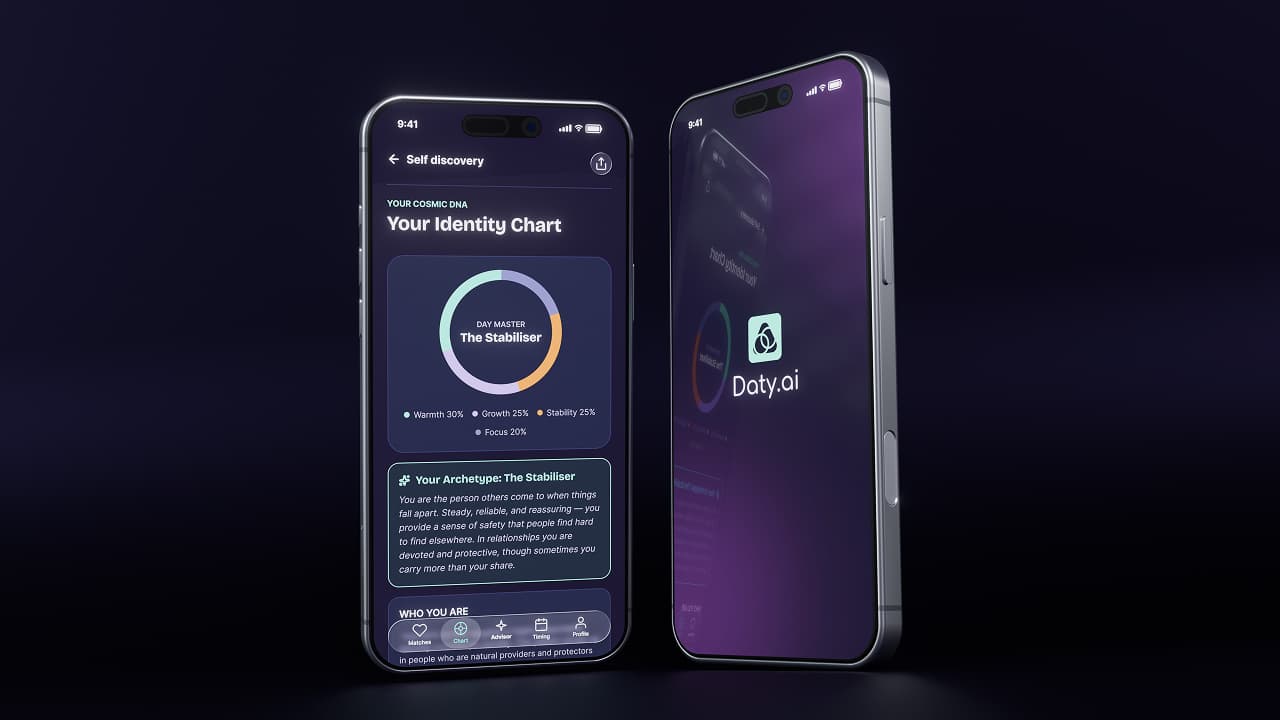
Daty.ai takes a different position: dating is a decision-intelligence problem. A meaningful recommendation should show the reasoning behind it. It should explain where two people align, where they may need care, and which early conversations can reveal whether the fit is real.
For a pair like Maya and Daniel, that explanation might prompt a grounded question before emotional momentum takes over: "When life gets hectic, what does staying connected look like to you?" The answer will not guarantee a relationship. It will reveal more than another perfectly edited prompt ever could.
The Trade-Off: Fewer Matches, More Signal
Behavioral compatibility is not a promise of frictionless love. No responsible system should make that claim. It may also produce fewer recommendations than an engagement-driven app, because it prioritizes evidence of fit over the volume of available faces.
For someone looking for entertainment, that can feel restrictive. For an intentional dater exhausted by dead-end conversations and repeated mismatches, it is the point.
There is also a privacy trade-off. Better behavioral insight requires users to share more meaningful context than a photo and a favorite restaurant. That information must be collected with consent, interpreted carefully, and presented without pretending an algorithm knows a person better than they know themselves. Explainability is not a nice feature. It is the standard that makes this kind of intelligence accountable.
The best system gives people clearer options, not false certainty. It helps them recognize a promising fit, name the risks honestly, and decide with their eyes open.
The next good match should not depend on who happened to see your profile at 10:42 p.m. It should begin with a better question: not just who seems attractive, but who can meet you in the patterns that make a relationship last.